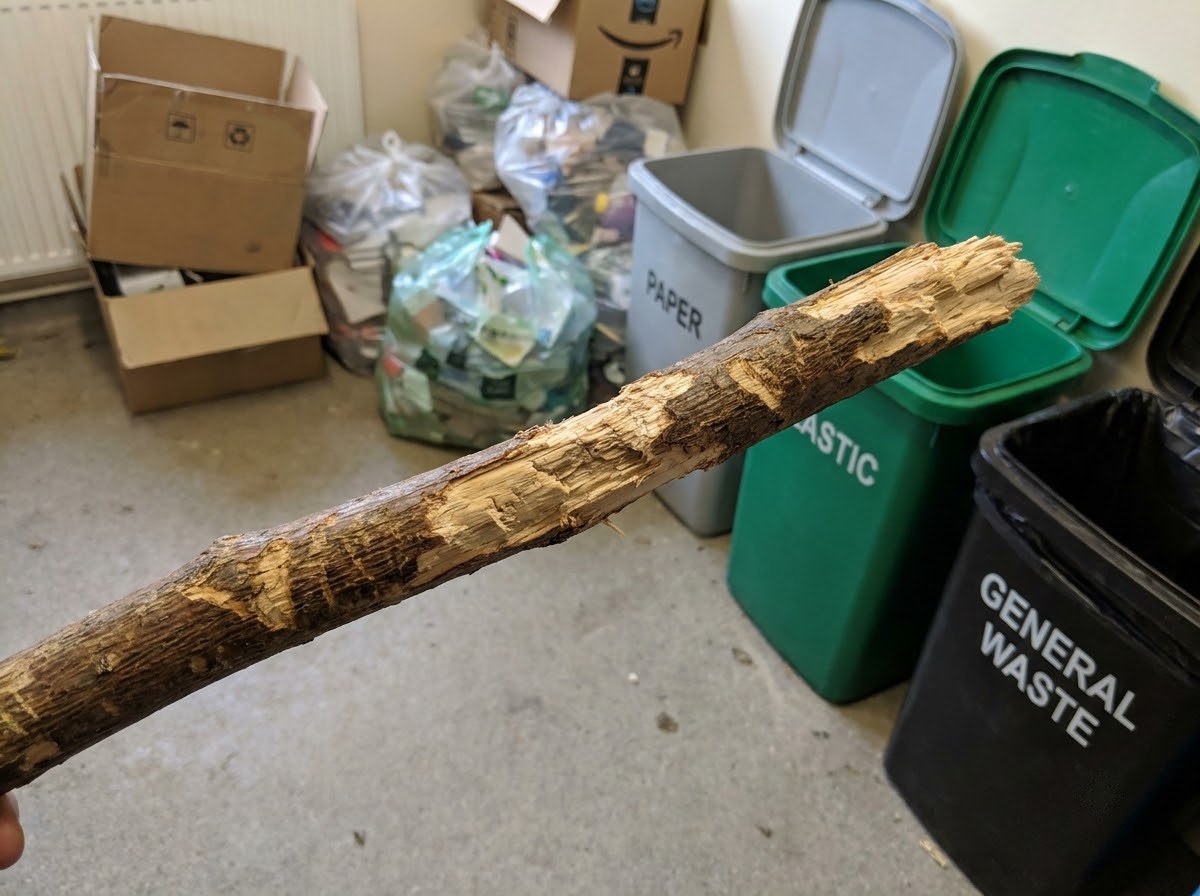
Retire damaged wood first, then check local disposal rules and product composition before choosing a waste route.
Know when play must end
Set aside a coffee wood chew that is cracked, sharp, or small enough to swallow. Do not wait for an estimated number of weeks; wear depends on the individual dog and use.
Keep retired pieces where pets cannot retrieve them. A worn toy is still capable of causing trouble if a dog finds and swallows it later.
Check the actual item
The catalog describes pruned coffee branch wood as the primary material for this product. Confirm whether any finish, attachment, or packaging is present on the specific item you own.
The public project does not document a disposal or compostability test for the finished chew. Avoid assuming all natural-looking items belong in a compost bin.
Follow local guidance
Municipal waste and compost rules vary. Ask your local provider whether untreated wood pieces are accepted and what size or preparation limits apply.
If you cannot verify the material or the local route, use the ordinary waste option your municipality specifies. Do not burn the item or make a home compost claim based on appearance alone.
Use disposal feedback for buying
Record why the chew was retired: cracks, sharpness, or reduced size. That observation can guide the next product decision and the questions you ask the seller.
A smaller environmental footprint cannot be inferred from disposal alone. Packaging, shipping, lifetime, and actual waste handling would all matter to a comparative claim.
A household disposal example
After a supervised session, an owner sees a new lengthwise crack. They remove the chew, pick up loose pieces, and store it out of the dog's reach. Later they check the product information and ask their municipality whether wood pieces of that type are accepted in a collection stream.
If the answer is uncertain, the owner follows the local ordinary-waste guidance. They do not put the item back into play, bury it for the dog to find, or advertise that it will become compost within a fixed number of months. The immediate safety decision and the waste decision are separate.
Questions to keep with the product
Ask whether the specific item has coatings, added components, or attached material; whether the local service accepts wood; and whether size preparation is required. Ask the seller for current composition information if the answer is unclear.
Keep the original label or a photo until disposal. This article concerns a household's end-of-use choice, while the environmental-claim article concerns what a retailer may say publicly. A responsible personal disposal choice is not proof for a marketing claim.
Keep small pieces away from pets
A retired chew should go into a closed container or the appropriate waste stream, not an open basket where the dog can take it again. Pick up separated pieces after a session and check the floor, mat, and nearby furniture. This is especially relevant in a household with other dogs or curious pets that did not use the chew originally.
If a piece was swallowed, the question is no longer disposal. Save the remaining chew, note when the event happened, and seek veterinary advice if ingestion or symptoms cause concern. Do not assume that a future waste choice resolves the immediate animal-use risk.
Ask the local service a precise question
Tell the waste provider what you know: a used dog chew whose primary material is coffee wood, approximate size, and whether any other component or coating is confirmed. Ask whether that item belongs in a particular collection stream. If they need a treatment or composition detail, request it from the seller rather than guessing.
Record the answer for your municipality and date. Another location may have different acceptance rules. This makes the household decision repeatable without claiming that a worn chew is universally recyclable, compostable, or suitable for garden soil.
When the municipal answer arrives, note whether it applies to the bare wood only or to a complete toy with other components. Do not separate attached parts by force if that creates sharp fragments or puts the item back within a dog's reach. Keep the retired piece contained while sorting the route. A cautious household process is preferable to an unsupported universal disposal instruction.
Frequently asked questions
Can I compost a worn coffee wood chew?
Check the finished product's composition and your local compost rules; no compostability test is documented here.
When should I discard the chew?
Retire it if it cracks, develops sharp edges, or becomes small enough to swallow.

Coffee Wood Chew Stick
Dense coffee wood chew made from branches collected during routine pruning in Vietnam's Central Highlands. Available in six sizes for supervised chewing.
Ask for current availability, packaging options, and a written quote.
Have Questions or Need a Wholesale Quote?
We export high-quality, pet-friendly coffee wood chews and natural toys worldwide.
Partner with us!
✨ Wholesale Pricing Available for Resellers & Business Partners!
We offer competitive wholesale prices and attractive deals for resellers and distributors.
💬 Feel free to message me directly to discuss pricing, partnership opportunities, and further details. Let's grow our businesses together! 🤝