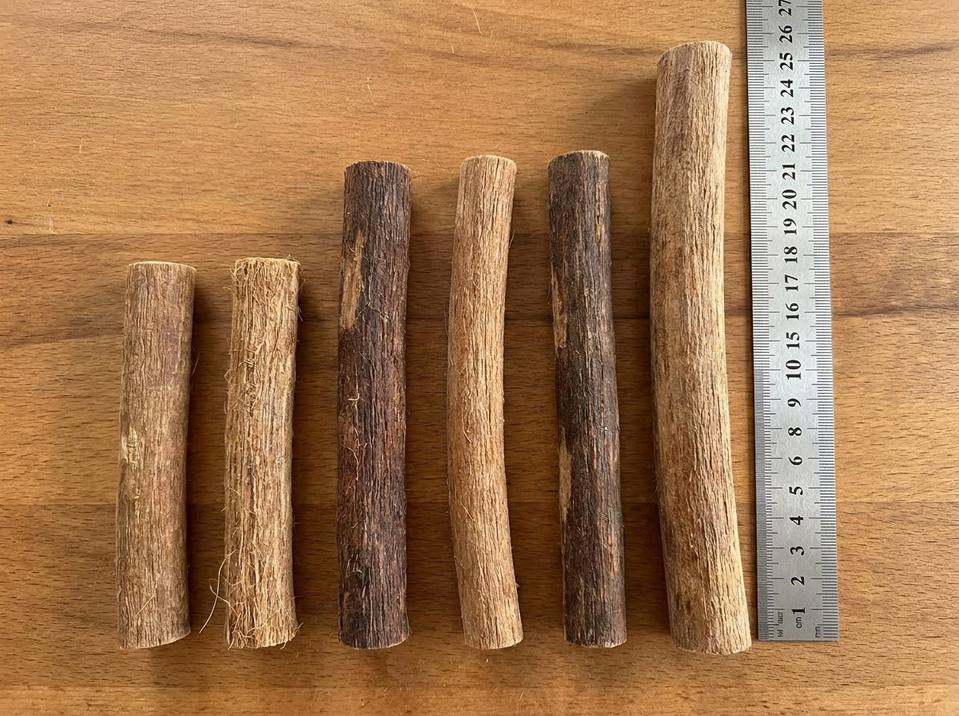
The catalog lists six size ranges. Use length and diameter as a starting point, then judge the actual dog and chew together.
Key takeaways
- XS is 12–13 cm long; XXL is 23–24 cm long.
- Length and diameter are catalog ranges, not exact dimensions for every natural piece.
- No breed or weight bracket guarantees fit.
The six listed dimensions
The catalog lists XS at 12–13 cm long and 1.5–2.0 cm in diameter; S at 13–15 cm and 2.0–2.8 cm; M at 17–18 cm and 2.8–3.2 cm. These are size ranges, so a natural piece may vary within its listed option.
The larger options are L at 18–20 cm long and 3.3–4.4 cm in diameter; XL at 21–22 cm and 4.5–5.4 cm; XXL at 23–24 cm and 5.5–6.5 cm. Compare both length and thickness, not only the size letters.
What length helps you assess
Length provides a first check against the dog's mouth. A piece that can disappear wholly into the mouth presents a swallowing concern and should not be offered.
The dog will wear the chew down over time. Recheck the remaining length during use; the label on its original packaging does not describe its current size.
What diameter helps you assess
Diameter describes thickness and changes how a dog can grip a piece. Observe whether the dog gnaws the surface or tries to crush, split or swallow it.
A thicker option is not automatically safer for an individual dog. Existing tooth condition, age and chewing behavior can change whether hard wood is appropriate at all.
Use the table as a starting point
Note the requested size and dimensions when contacting the supplier. If you can examine a sample, compare its actual length, diameter, edges and grain before a session.
Avoid converting the six ranges into unsupported breed or body-weight assignments. If the dog's mouth fit or dental suitability is unclear, ask a veterinarian before use.
Work through a dimension comparison
Suppose a buyer is comparing M and L. M is listed at 17–18 cm by 2.8–3.2 cm, while L is 18–20 cm by 3.3–4.4 cm. The length ranges nearly meet, but the diameter ranges differ more noticeably. That tells the buyer to examine grip and mouth fit in addition to length. It does not tell the buyer that either size is approved for a named breed or body weight; those judgments require the individual dog.
For a wholesale inquiry, write the size name and both catalog ranges on the request. Ask for current sample dimensions and acceptable variation if exact sizing affects a label or display. For a pet owner, the more immediate question is whether the actual piece can be swallowed or damaged in use. Measure the worn piece again later: the dimensions printed for a new chew will not remain true after repeated chewing.
Why two measurements matter
Imagine two sticks that are both roughly 18 cm long. One sits near the upper end of the M length range; another sits at the lower end of the L range. Their diameters may differ enough to change how an individual dog holds them. A size letter compresses this information, so record the length and diameter separately. The catalog's ranges describe product options, not a guarantee that a specific dog can safely use every sample within a range.
For an online order inquiry, include the requested size name and both ranges in the message. When a sample arrives, check the actual piece against the request and assess the dog's mouth fit. If a retailer needs precise packaging copy, confirm current specifications instead of copying an approximate dimension into a promise. Natural material and size ranges make sample inspection especially useful.
Avoid translating sizes into breed rules
Two dogs of the same breed can differ in mouth shape, chewing force, age and dental condition. A chart that maps XS to a named small breed and XXL to a named large breed may look convenient, but the supplied catalog does not provide that validation. A breed example can prompt a question, not settle a fit decision. The owner still needs to see whether the individual dog can swallow the actual piece or break it into large chunks.
Also reconsider the size after the chew has worn. An originally XL piece does not remain XL in practical mouth fit forever. Inspect the ends, remaining length and any new cracks before each session. If a piece is borderline, remove it and ask for an alternative. The six catalog options create a choice set; supervision and ongoing fit checks determine whether a choice remains suitable.
Frequently asked questions
How many coffee wood chew sizes are listed?
Six: XS, S, M, L, XL and XXL.
Does the catalog assign sizes by dog weight?
No. It lists product dimensions; fit must be assessed for the individual dog.

Coffee Wood Chew Stick
Dense coffee wood chew made from branches collected during routine pruning in Vietnam's Central Highlands. Available in six sizes for supervised chewing.
Ask for current availability, packaging options, and a written quote.
Have Questions or Need a Wholesale Quote?
We export high-quality, pet-friendly coffee wood chews and natural toys worldwide.
Partner with us!
✨ Wholesale Pricing Available for Resellers & Business Partners!
We offer competitive wholesale prices and attractive deals for resellers and distributors.
💬 Feel free to message me directly to discuss pricing, partnership opportunities, and further details. Let's grow our businesses together! 🤝