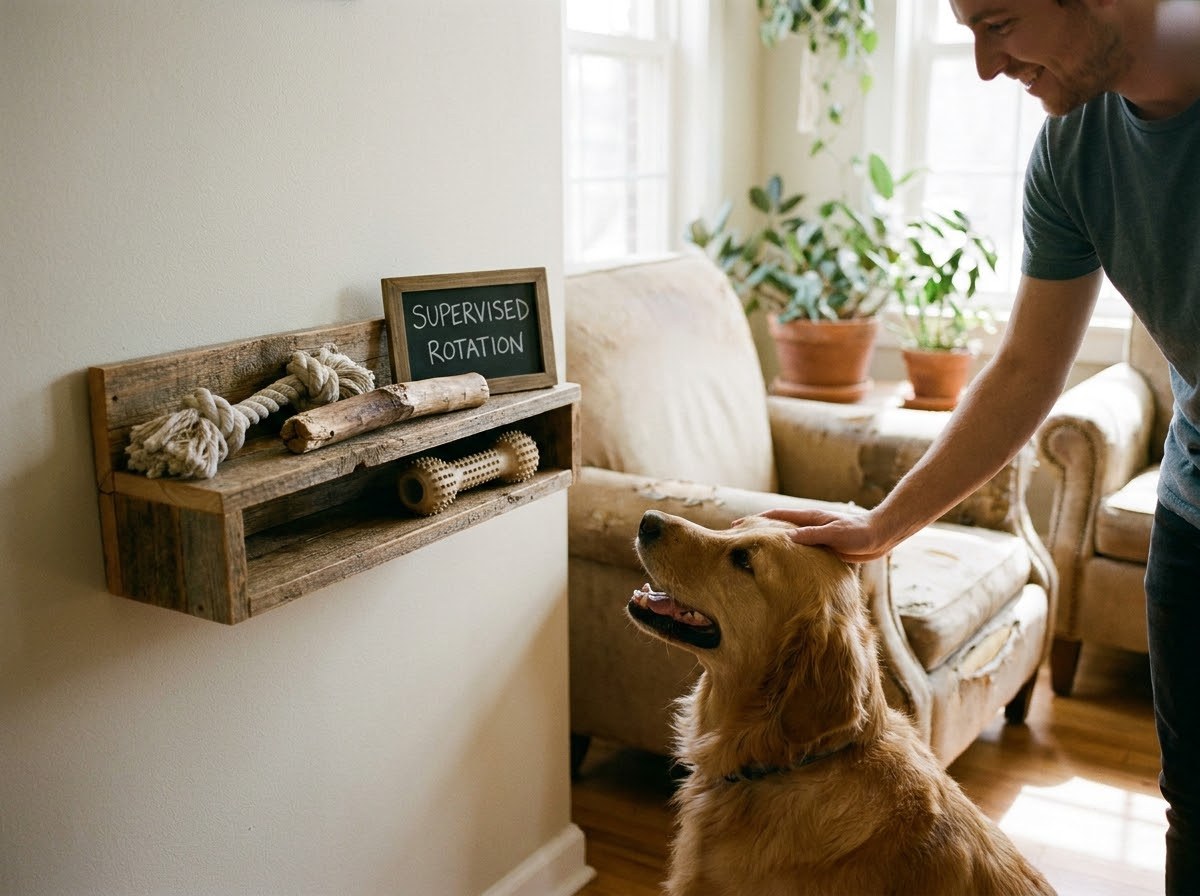
Plan a small toy rotation around your dog's play style, inspection needs, and active supervision.
Start with different types of play
A coffee wood chew supports supervised gnawing; a rope tug supports an interactive game; a rubber toy offers another shape and texture. These objects do different jobs, so variety need not mean several wood chews.
Watch what the individual dog actually does with each toy. Repeatedly ignoring one option is useful information, not a reason to pressure the dog to use it.
Keep a simple rotation
Select a few intact toys and put the rest away clean and dry. Offer one appropriate option during a supervised session, then change it on another day.
There is no proven rotation interval for this particular product. Choose a schedule that makes inspection and active observation realistic for your household.
Check each material differently
Wood can fray or crack; rope can loosen; rubber can tear. A rotation only works when each item is inspected before and after use.
Retire damaged toys regardless of how recently they were purchased. Do not keep a damaged chew in the rotation because it is a favorite.
Adjust to the dog and household
If the dog gulps pieces or guards toys, pause access and address that behavior separately. In multi-dog homes, separate stations and direct supervision may be needed.
The goal is suitable engagement, not a fixed number of toys. Ask your veterinarian about chew choices when dental or digestive concerns change what the dog can handle.
A three-option rotation example
One household might keep an intact wood chew for a quiet supervised session, a rope tug for play with a person, and a rubber toy for a different texture. The owner selects the activity first, then the toy, instead of offering all three together. The dog has a chance to show which option it prefers that day.
If the rope develops loose strands, it leaves the rotation. If the wood develops a crack, it leaves as well. The next session does not become a test of whether the damaged favorite can last longer. Each material needs its own stop rule, and no rotation schedule can replace inspection.
Keep a useful toy log
For a week, note the toy, what the dog did with it, whether a person could supervise, and what wear appeared. A one-line note such as 'held the wood but tried to bite off the end' gives more information than a rating of how much the dog liked it.
Use the log to remove poor matches and repeat activities that fit the dog's behavior. If several toys cause swallowing attempts or apparent mouth discomfort, pause the rotation and discuss the pattern with a veterinarian. Variety is useful only when the options remain appropriate.
Rotation is a choice of activity
Think of a rotation as a set of play opportunities rather than a row of products that must all be used. A wood chew asks for close observation of gnawing and wear. A tug asks for a person to lead and end an interactive game. A soft rubber toy may suit a different kind of engagement. Selecting the activity first prevents the owner from offering a hard chew simply because it is next on a calendar.
A weekly plan could include two supervised chewing opportunities and several interactive sessions, but that is only an example, not a recommended dose. Adjust it to the dog's interest and the household's capacity to watch. If a day is too busy for active supervision, postpone the wood chew. The dog's behavior during a session matters more than whether every toy was used that week.
Avoid competition between toys
In a shared household, placing several toys out at once can change how dogs interact with each other. One dog may guard a resource while another approaches it. A rotation should therefore specify who has access, where the activity happens, and how an owner will separate dogs when needed. Do not assume that offering duplicate wood chews removes competition.
After each session, put away the toy before another dog enters the area, then inspect and clean it as appropriate to its material. If guarding or conflict appears, pause the setup and seek help from a qualified behavior professional. The rotation plan is a convenience for organizing safe opportunities, not a treatment plan for resource guarding.
Frequently asked questions
How often should I rotate dog chew toys?
There is no required interval; rotate when you can supervise and inspect each option.
Can I leave the wood chew out all day?
Use it during supervised sessions and put it away when you cannot monitor chewing.

Coffee Wood Chew Stick
Dense coffee wood chew made from branches collected during routine pruning in Vietnam's Central Highlands. Available in six sizes for supervised chewing.
Ask for current availability, packaging options, and a written quote.
Have Questions or Need a Wholesale Quote?
We export high-quality, pet-friendly coffee wood chews and natural toys worldwide.
Partner with us!
✨ Wholesale Pricing Available for Resellers & Business Partners!
We offer competitive wholesale prices and attractive deals for resellers and distributors.
💬 Feel free to message me directly to discuss pricing, partnership opportunities, and further details. Let's grow our businesses together! 🤝