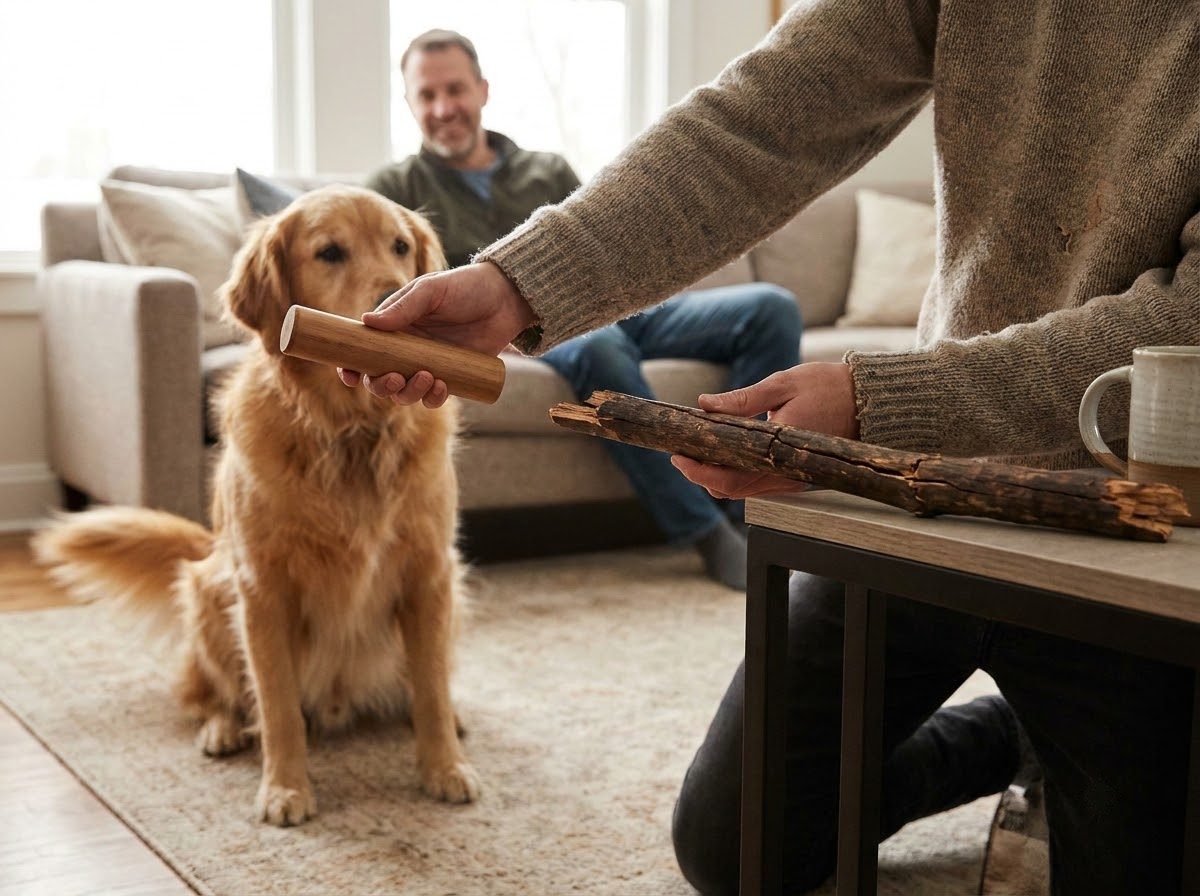
Damage is a present-tense decision. Remove a cracked, sharp or swallowable chew even if it was recently purchased.
Retire for a crack or sharp edge
The product instructions say to replace the chew if it cracks or develops sharp edges. A deep split can change quickly under chewing pressure.
Do not file, glue or wrap a damaged chew to extend its use. Choose an intact replacement or another form of enrichment.
Retire when it becomes swallowable
Check the worn piece against the dog's mouth. If it could fit wholly inside, it is too small to offer again.
There is no universal number of weeks or one-third-length rule. Chewing style and the individual's mouth determine when a piece has worn too far.
Retire after risky chewing
A dog that snaps off chunks or tries to gulp wood may need a different toy even if the remaining stick appears intact. Watch behavior as closely as the object.
Stop the session immediately when large pieces separate. Seek veterinary advice if you suspect a fragment was swallowed.
Replace thoughtfully
If trying a new piece, reassess its size and inspect its surface from the start. Do not assume the same labeled size will suit a dog whose behavior has changed.
Ask about dental concerns before returning to hard chewing. Retirement is a normal part of supervised toy use, not proof of a defect or a fixed product lifespan.
Damage-first replacement decisions
This guide answers a different question from the too-small fit check: whether damage alone requires retirement. A long coffee wood chew with a deep split should be removed even when it remains far too large to swallow whole. The concern is a piece breaking away under pressure or a sharp edge contacting the mouth. Likewise, a loose chunk is a reason to stop without waiting for the entire stick to wear shorter.
Use a short decision sequence when you find damage: take the chew away, check whether a fragment is missing, observe the dog, and contact a veterinarian if ingestion is suspected or symptoms appear. Then choose whether an intact replacement suits this dog's chewing behavior. Repeated splitting may point toward a mismatch in activity, not simply a need to purchase the same item again. Record the visible reason for retirement so it is not put back into play.
Apply a damage-first rule
Suppose a newly purchased XL chew develops a deep lengthwise split after one session. It remains long enough that the dog cannot swallow it whole, yet the split may allow a large piece to detach. Remove it for damage. Conversely, a smooth-looking worn stub may fail the mouth-fit check without any crack. The two examples show why retirement decisions need more than product age or one length rule.
A sharp projection can also arise from a damaged end. Do not sand a suspicious chew and put it back into use without product guidance; the underlying split may remain. Set it aside where the dog cannot retrieve it, account for any missing pieces and choose an intact alternative only after reassessing the dog's chewing style. If the dog repeatedly breaks wood, a different activity may be more appropriate than another identical stick.
Make the replacement decision separately
Retiring a damaged piece does not automatically mean the product category is unsuitable for every dog. Ask what caused the damage you observed: gradual wear, a forceful snapping behavior, a piece dropped onto a hard surface or an unknown event. You may not know the cause, so avoid diagnosing a manufacturing defect from appearance alone. Photograph the issue if you need to raise it with the seller and request current product information.
For the next session, begin with an intact piece of appropriate dimensions, supervise, and inspect before and after. If the same dog keeps creating sharp splits or swallowing chunks, stop using wood chews and ask a professional about alternatives. The older lifespan guide addresses how a toy changes over time; this page gives a stop decision for visible damage at any age. That narrower purpose helps prevent two URLs from repeating the same calendar-based advice.
Frequently asked questions
Can a new chew need retiring?
Yes. Remove any piece that cracks, gets sharp or is small enough to swallow, regardless of age.
Is wear alone enough to retire it?
Look at the resulting size and surface condition; retire it when those create a concern.

Coffee Wood Chew Stick
Dense coffee wood chew made from branches collected during routine pruning in Vietnam's Central Highlands. Available in six sizes for supervised chewing.
Ask for current availability, packaging options, and a written quote.
Have Questions or Need a Wholesale Quote?
We export high-quality, pet-friendly coffee wood chews and natural toys worldwide.
Partner with us!
✨ Wholesale Pricing Available for Resellers & Business Partners!
We offer competitive wholesale prices and attractive deals for resellers and distributors.
💬 Feel free to message me directly to discuss pricing, partnership opportunities, and further details. Let's grow our businesses together! 🤝