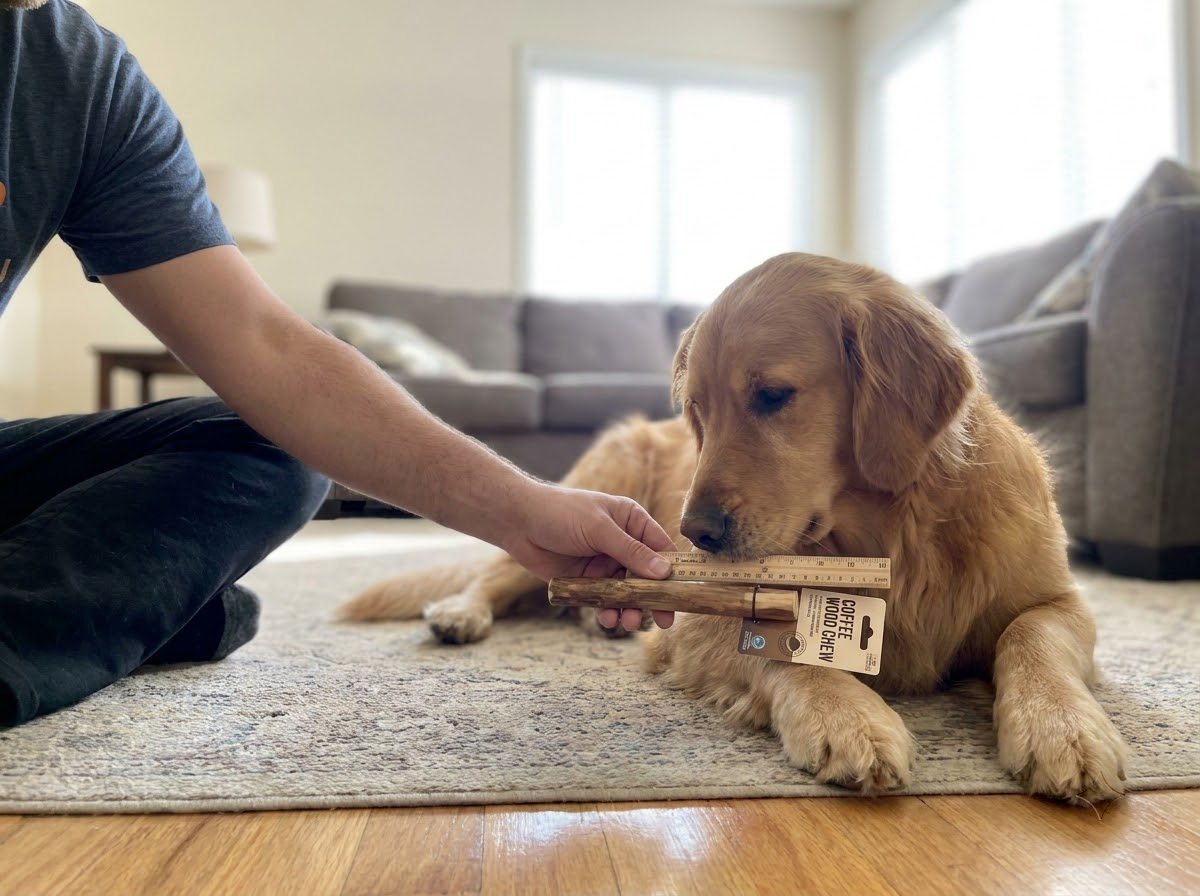
A catalog size is only a starting measurement. The safer decision depends on the dog's actual mouth and chewing behavior.
Key takeaways
- Compare the real piece with the individual dog.
- Reject a piece the dog could swallow whole.
- Repeat the check as the chew wears down.
Start with the actual piece
Read the catalog length and diameter, then look at the specific chew you intend to offer. Natural wood and a size range make a physical check more useful than a label alone.
Hold the chew near the dog without forcing it into the mouth. Ask whether the dog could take the whole piece deeply into its mouth, particularly after it wears shorter.
Observe how the dog handles it
During a supervised trial, a dog may hold the stick and work gradually at an exposed surface. Watch for forceful snapping, swallowing attempts or large pieces separating.
If the dog tries to gulp it or break it into chunks, take it away. Changing to a larger size is not a guaranteed solution for every chewing style.
Recheck after wear
A piece that looked sufficiently long on day one can become too short later. Inspect both ends and compare its remaining size with the dog's mouth before each session.
Cracks, sharp edges and loose chunks are separate reasons to retire it even if overall length still seems generous. Do not wait for a fixed calendar interval.
When dimensions are not enough
A dog's dental history, age and tendency to swallow objects matter alongside physical dimensions. A weight chart cannot capture those individual differences.
Ask a veterinarian about dental pain, prior fractures or recent treatment before offering a hard chew. Choose another enrichment format if this one does not suit the dog.
Three observations to make together
First, compare a real stick with the dog's mouth before offering it. Second, watch how far the dog can draw it inside while holding or turning it. Third, inspect the piece after a session to see whether one end has narrowed or broken. Those observations make a fit decision more concrete than a breed chart. If the answer changes at any step, take the chew away and reassess instead of relying on the original label.
For example, two chews can share the same catalog length but differ in thickness within a listed range. A dog may hold one across the front of the mouth and push the narrower one farther back. This does not produce a universal diameter threshold, but it shows why the actual object matters. Avoid forcing a size test inside a dog's mouth; observe normal handling during close supervision and ask a veterinarian when dental condition is part of the uncertainty.
Mouth fit is a moving target
At purchase, the owner can compare a new chew against the dog's muzzle and mouth opening. During use, the dog may rotate it, grip one end and move a narrow section farther back. After use, the object can be shorter or irregular. Those three moments may produce different answers even for the same dog. Instead of declaring a permanent fit from one glance, check the current piece each time it is offered and watch normal handling without forcing a measurement inside the mouth.
A useful observation is whether both ends remain visibly outside the mouth while the dog holds the chew. That is not a universal clearance test, because a chunk could still separate and be swallowed. It does, however, highlight an obvious reason to remove a piece that has become a small stub. Assess cracks and sharp edges separately from length. A piece can be long enough and still damaged.
When a larger size is not the answer
If a dog snaps wood into chunks, moving up one catalog size may not change its behavior. Likewise, a dog with a painful tooth may not benefit from a thicker or longer hard object. The decision may be to switch to an activity with a different texture or to get veterinary advice. A product range exists to offer dimensions, not to guarantee that every dog has a suitable choice somewhere on the list.
For a household decision, write down why the current piece failed: swallowed-whole risk, cracking, sharp damage, forceful breaking or apparent discomfort. Each reason points to a different follow-up question. A size change addresses only some fit problems; it cannot repair cracked wood or diagnose an oral condition. This record prevents repeated purchases based on the same unsupported assumption.
Frequently asked questions
Can I choose a coffee wood chew by breed alone?
No. Use the actual dog's mouth size, chewing style and dental condition.
Should mouth fit be checked only when buying?
No. Repeat the check as the chew wears shorter and inspect for damage each time.

Coffee Wood Chew Stick
Dense coffee wood chew made from branches collected during routine pruning in Vietnam's Central Highlands. Available in six sizes for supervised chewing.
Ask for current availability, packaging options, and a written quote.
Have Questions or Need a Wholesale Quote?
We export high-quality, pet-friendly coffee wood chews and natural toys worldwide.
Partner with us!
✨ Wholesale Pricing Available for Resellers & Business Partners!
We offer competitive wholesale prices and attractive deals for resellers and distributors.
💬 Feel free to message me directly to discuss pricing, partnership opportunities, and further details. Let's grow our businesses together! 🤝