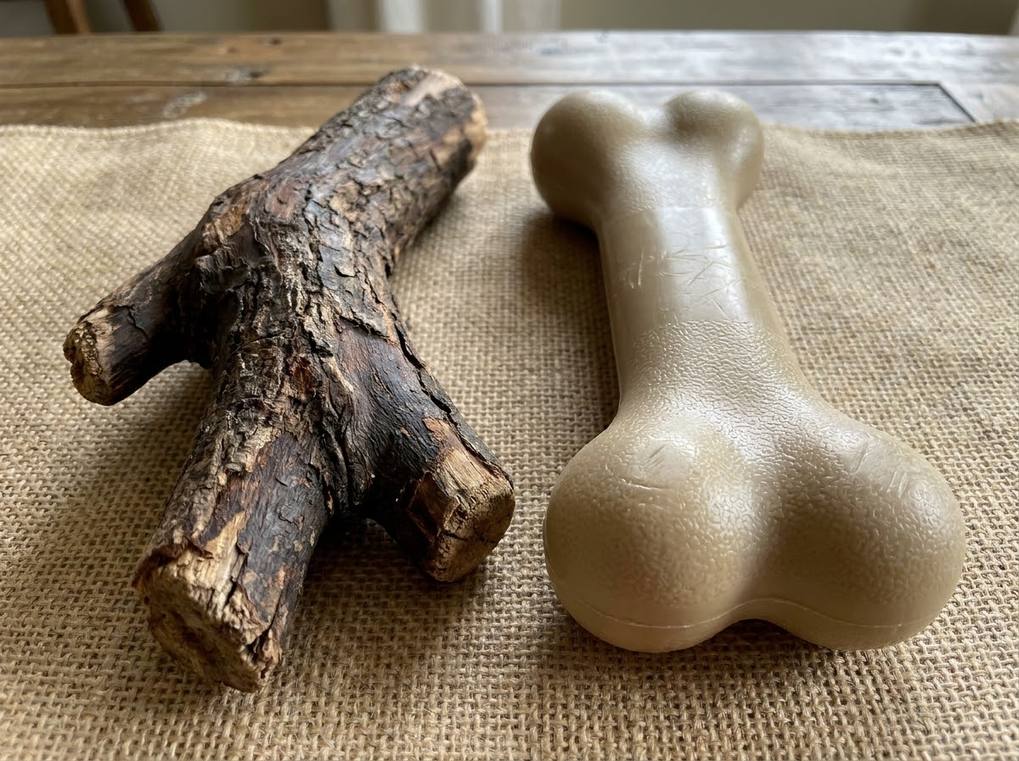
Wood and nylon can both be firm chew materials. Compare the actual toys and your dog's behavior rather than assuming either is universally safer.
Material and form
The Eco Pet Toys chew is pruned coffee-tree branch wood available in six catalog size ranges. Nylon toys are manufactured polymers with forms that vary by brand and model.
Compare the actual products' dimensions and surface, not broad material labels. A shaped nylon toy and a natural wood stick may present very different gripping patterns.
Watch how each wears
The coffee wood description says its surface can wear and fray. Retire it when it cracks, develops sharp edges or becomes small enough to swallow.
A nylon toy can also develop damaged edges or detached pieces. Follow that product's instructions and remove it when its wear creates a concern.
Consider the dog's mouth
Neither material is automatically appropriate for a dog with dental pain, fragile teeth or a history of fractures. Hard chewing suitability is an individual veterinary question.
Observe whether the dog gnaws gradually or clamps forcefully. A dog that tries to swallow fragments may need a different type of enrichment.
A useful buying checklist
Compare size, condition, how the dog handles the toy and how easily you can inspect wear. Ask for material or test documentation if a specific claim influences your purchase.
Do not infer an environmental or dental advantage from appearance alone. Choose the option you can supervise and maintain appropriately for this dog.
What a fair comparison looks like
Take one intact wood chew and one specific nylon toy of an appropriate size. Record their dimensions, instructions and visible wear after separate supervised sessions. If the dog works gently at one and tears pieces from the other, that observation matters more than a generic claim about wood or plastic. If the dog damages both, neither is suitable in its current form. A comparison should describe this dog and these products, not announce a universal material winner.
For buyers concerned about composition, request current material and test documentation for the exact items under consideration. The coffee wood catalog identifies its branch material but does not supply a public certificate proving a broad environmental or medical claim. Nylon products also vary. A clear decision may simply be to choose the item whose fit, instructions and wear can be managed for the dog, or to ask a veterinarian to recommend a different texture.
Compare specific products, not categories
A coffee wood chew has a published set of six size ranges. A nylon toy may be a solid bone shape, a textured ring or another design, each with its own dimensions and instructions. A fair comparison writes down the exact two products, the dog's mouth fit and how each is used. If the nylon piece is too small, comparing its material with a suitably sized wood chew tells you little. Fit problems must be resolved before drawing conclusions about preference or wear.
Observe the dog in separate supervised sessions. Does it scrape the wood surface, damage the nylon edge, attempt to swallow either object or avoid one texture? Record only what you see. One dog's reaction is not a controlled study of material safety. If the dog shows oral discomfort with either hard toy, stop and ask a veterinarian before continuing. The decision should be about the individual object and animal.
Handle environmental claims carefully
The catalog says the coffee wood comes from pruned branches. That is a material and sourcing description, not a full lifecycle comparison with nylon. To claim that one toy has a lower footprint, a buyer would need information about processing, packaging, transport, use and end-of-life handling for both products. Those records are not available in the public listing. Avoid turning a natural appearance into a quantitative environmental promise.
A retailer can still explain the verified material in plain language and provide care instructions. If environmental positioning is important, ask suppliers for current documentation and define exactly which claim it supports. Pet owners may choose based on material preference, fit and observed use without pretending those preferences prove a global sustainability ranking. Both products should be retired when damaged; neither should be offered because an unsupported comparison calls it universally safer.
Frequently asked questions
Is coffee wood always safer than nylon?
No. Suitability depends on the individual dog, the particular toy and how it is used and inspected.
Do both materials need inspection?
Yes. Remove any chew that develops dangerous wear or pieces a dog could swallow.

Coffee Wood Chew Stick
Dense coffee wood chew made from branches collected during routine pruning in Vietnam's Central Highlands. Available in six sizes for supervised chewing.
Ask for current availability, packaging options, and a written quote.
Have Questions or Need a Wholesale Quote?
We export high-quality, pet-friendly coffee wood chews and natural toys worldwide.
Partner with us!
✨ Wholesale Pricing Available for Resellers & Business Partners!
We offer competitive wholesale prices and attractive deals for resellers and distributors.
💬 Feel free to message me directly to discuss pricing, partnership opportunities, and further details. Let's grow our businesses together! 🤝