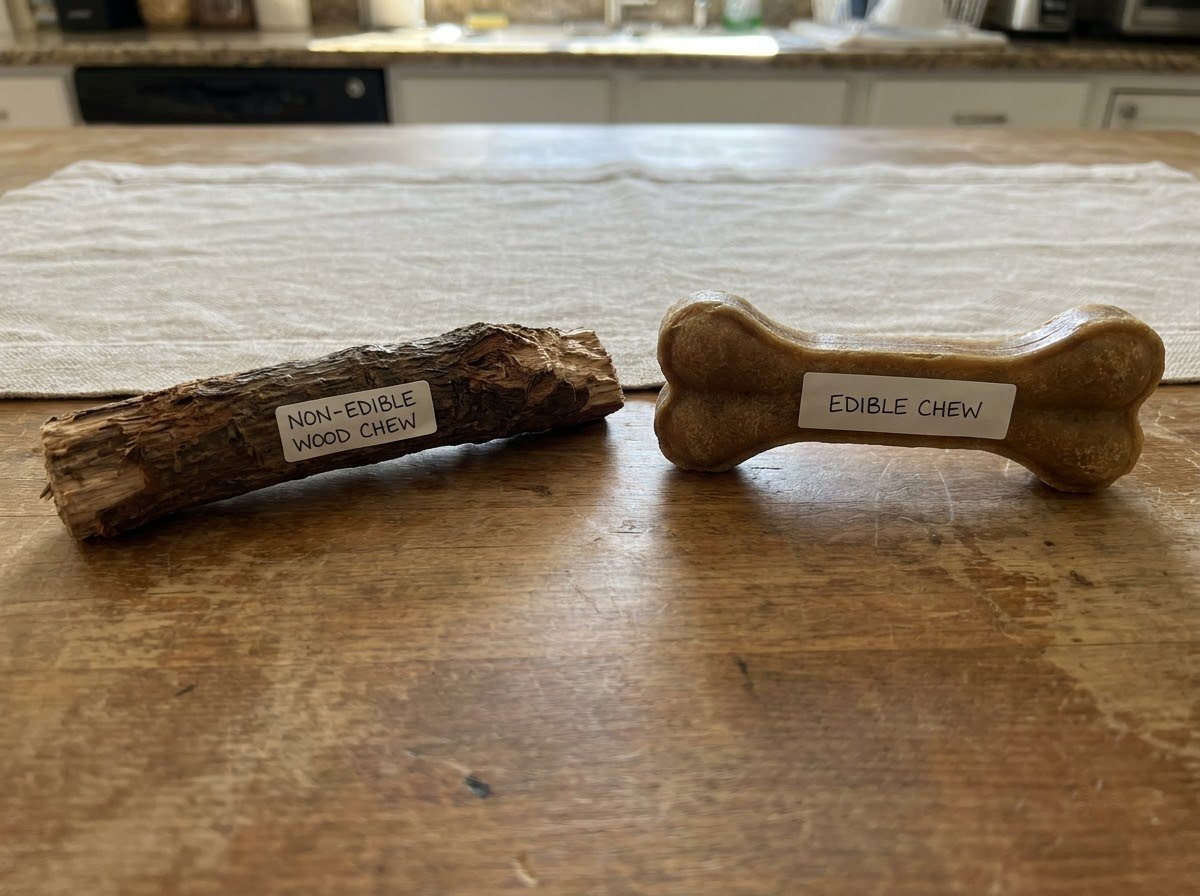
Coffee wood is offered as a toy to gnaw under supervision. Edible chews are food products with their own ingredients and feeding directions.
Toy or food
The coffee wood chew is pruned branch wood and is not marketed as food. Do not count its fibers as a treat or intended part of the dog's diet.
An edible chew is meant for consumption according to its label. Its ingredients, portion and suitability need a separate dietary assessment.
Questions for each product
For the wood toy, ask about dimensions, mouth fit, cracks and the dog's chewing style. Retire the piece if sharp damage or swallowable size develops.
For an edible chew, read ingredients, feeding instructions and size guidance. Ask a veterinarian about diet restrictions or health conditions.
Different risks to watch
A non-edible toy can break or be swallowed if it becomes damaged or too small. Watch every coffee wood session and remove loose pieces.
An edible chew can still present choking or digestive concerns depending on the product and dog. Follow its label and professional advice rather than assuming edible means risk-free.
Choose by your purpose
If the purpose is supervised gnawing without a food reward, evaluate a suitable toy. If the purpose is a consumable reward, assess an edible product's ingredients and portion.
These categories are not interchangeable. A dog that tries to eat wood may need a different toy, while a dog with diet restrictions may need a different treat.
A two-column label check
Before buying, write two headings: 'object to keep' and 'product to consume.' Under the first, list fit, material, wear, cleaning and retirement conditions. The coffee wood chew belongs there because the dog should gnaw it without swallowing pieces. Under the second, list ingredients, serving amount, calories if provided and dietary restrictions. An edible chew belongs there because consumption is its intended use. The lists prevent a shared word in product names from hiding different responsibilities.
If a dog with a restricted diet needs an activity, a non-edible toy may avoid adding a food reward, but it still needs dental suitability and supervision. If a dog tends to break and gulp toys, an edible product is not automatically a solution either; its size and feeding instructions matter. Ask a veterinarian about the individual dog's behavior and health before switching categories as a workaround. Neither category can be assessed responsibly from the word chew alone.
Read the evidence each category provides
A non-edible toy listing should make its material, dimensions and use instructions clear. The Eco Pet Toys wood chew identifies pruned branch wood and six sizes, then instructs supervised use and replacement when damaged. It does not provide a nutrition panel because the object is not offered as food. An edible chew should instead disclose ingredients and feeding guidance according to the seller's product information. Do not use a wood toy page to answer dietary questions it was never designed to address.
The word natural does not settle the difference. A natural-material toy can still be unsuitable if it breaks into swallowable pieces, while an edible product can still require portion control or be inappropriate for a dog's diet. Evaluate the specific item according to its intended use. If its category is ambiguous, ask the seller explicitly whether consumption is intended before offering it to an animal.
A household decision example
A caregiver wants a dog to have a supervised activity between meals without changing its diet. A non-edible toy may meet that purpose if it fits the dog's mouth, tooth condition and chewing style. Another caregiver wants a consumable reward after training; an appropriately selected edible chew or treat may serve that different purpose. In both situations, the dog still needs observation and the product instructions matter. Neither answer can be chosen from the shared word chew alone.
If a dog starts trying to consume the wood rather than gnaw the surface, end the session. If it gulps an edible chew whole, reassess that product too. Contact a veterinarian about swallowed non-food pieces or dietary concerns. Keeping toy and treat storage separate can also prevent someone from accidentally offering the wrong category. The distinction has practical consequences in shopping, supervision and communication across a household.
Frequently asked questions
Is coffee wood an edible dog chew?
No. It is a non-edible wooden chew toy and should be used under supervision.
Does edible mean a chew is safe for every dog?
No. Check the specific product and ask a veterinarian about diet or health concerns.

Coffee Wood Chew Stick
Dense coffee wood chew made from branches collected during routine pruning in Vietnam's Central Highlands. Available in six sizes for supervised chewing.
Ask for current availability, packaging options, and a written quote.
Have Questions or Need a Wholesale Quote?
We export high-quality, pet-friendly coffee wood chews and natural toys worldwide.
Partner with us!
✨ Wholesale Pricing Available for Resellers & Business Partners!
We offer competitive wholesale prices and attractive deals for resellers and distributors.
💬 Feel free to message me directly to discuss pricing, partnership opportunities, and further details. Let's grow our businesses together! 🤝