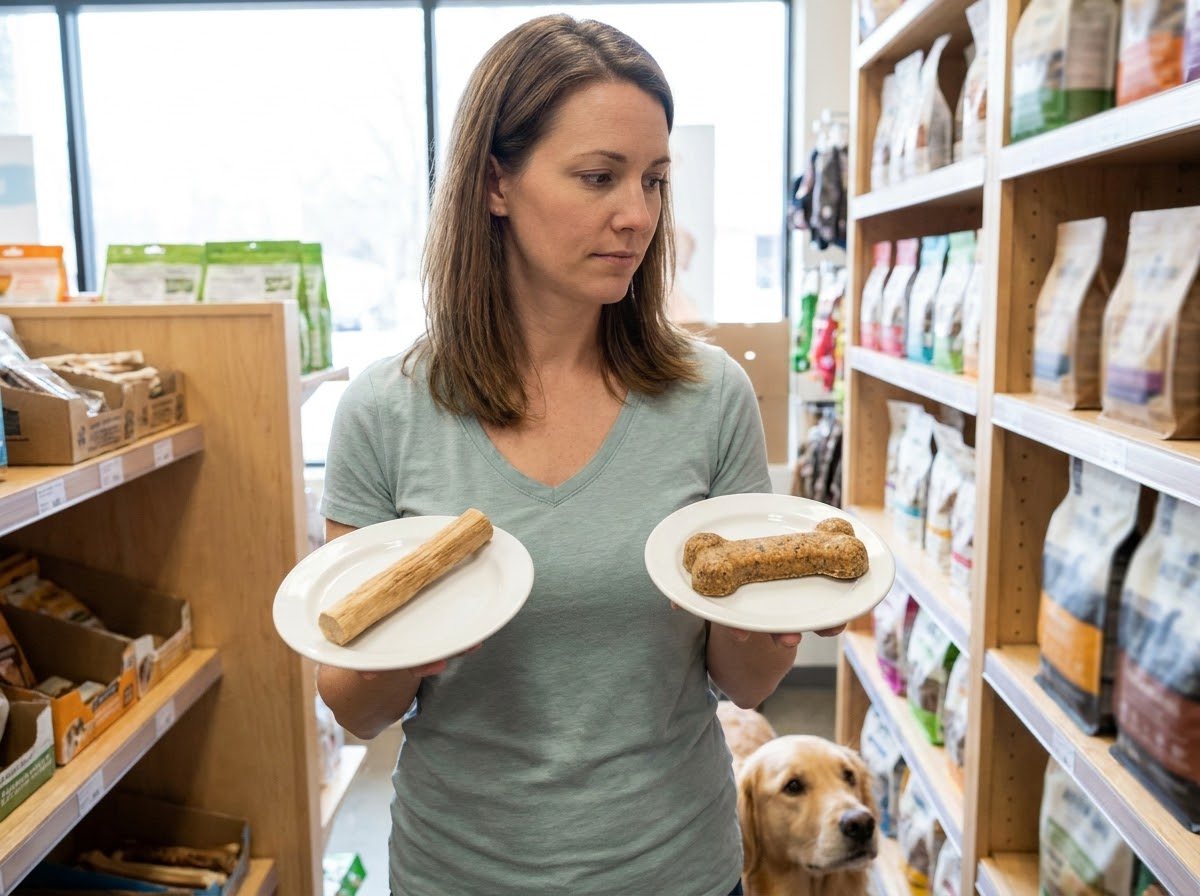
The word chew can describe both a toy and a consumable. This checklist helps buyers identify what they are actually purchasing.
Read the product category
The Eco Pet Toys coffee wood chew is a dog toy made from pruned branch wood. It is meant for supervised gnawing, not for feeding.
A treat should identify edible ingredients and feeding directions. Do not infer edibility from a product name that contains the word chew.
Check the questions that matter
For a wood toy, compare current size with the dog's mouth and inspect for cracks, sharp edges and loose chunks. Ask whether the dog's chewing style suits a hard object.
For a treat, check ingredients, portions and any relevant dietary restrictions. Discuss uncertain health or dental suitability with a veterinarian.
Watch the dog's behavior
A dog may gnaw a toy normally or may try to break and gulp it. Stop a wood session if the latter happens, even if the piece initially looked suitable.
A dog may also gulp an edible chew without chewing it adequately. Product instructions and supervision still matter.
Make an informed inquiry
When contacting a seller, name the exact product and size instead of asking generally for a coffee chew. Ask for the current listing and any material documentation needed for your decision.
If you intended to buy food, confirm that the item is explicitly sold as an edible product. The coffee wood chew on this site is not one.
An inquiry that prevents category confusion
A buyer can write: 'I am asking about the coffee wood chew stick for dogs, size M, which the catalog lists at 17–18 cm long and 2.8–3.2 cm in diameter. Is the current product a non-edible toy, and can you confirm the available sample dimensions?' This gives the seller an exact item and a checkable fact. If the buyer wants a snack instead, they should say 'edible treat' and ask for ingredients and feeding guidance from a seller that offers one.
When the item arrives, confirm the package and object match the inquiry. A toy should not be fed just because it was offered under a 'chew' category. For a household with several caregivers, store treats and toys separately and explain the difference to anyone who offers them to the dog. The checklist has a practical purpose: it stops an ambiguity in marketing language from becoming an unsafe assumption during use.
Use four questions at the shelf
Ask whether the item is sold as food, what it is made from, how the dog is meant to use it and what condition means it should be removed. For the coffee wood chew, the answers point to a non-edible branch-wood toy for supervised gnawing, with retirement when it cracks, becomes sharp or is small enough to swallow. For a food treat, the packaging should instead answer ingredient and feeding questions. A missing answer is a reason to ask the seller, not to guess.
A photograph of a dog holding a stick or treat does not establish category. Check the written product description. If a listing uses phrases such as 'natural chew' without saying whether it is edible, request clarification before buying. That small step is especially useful when comparing products across different shops where names and categories vary.
Keep the answer clear after purchase
Write the use rule on the storage container if multiple caregivers share responsibilities: this wood toy is for observed sessions and is collected afterward. Treats stay in a separate food area with their feeding instructions. The label need not make a safety promise; it only prevents category confusion. A new caregiver should know that detached wood is not an intended snack and that a worn piece is not offered again.
If a buyer contacts Eco Pet Toys, specifying the product slug or the coffee wood chew stick and desired catalog size avoids a quote for another toy. Ask about the current product and dimensions before assuming the catalog's approximate range describes the exact piece available today. The final purchase decision still depends on the dog. The checklist helps identify the product accurately; it cannot establish dental or behavioral suitability without observation and, when needed, professional advice.
Frequently asked questions
Can my dog eat the coffee wood chew as a treat?
No. Treat it as a supervised non-edible toy and remove damaged or swallowable pieces.
Why does the word chew appear in both categories?
Chew describes an action; the product's material and instructions establish whether it is a toy or food.

Coffee Wood Chew Stick
Dense coffee wood chew made from branches collected during routine pruning in Vietnam's Central Highlands. Available in six sizes for supervised chewing.
Ask for current availability, packaging options, and a written quote.
Have Questions or Need a Wholesale Quote?
We export high-quality, pet-friendly coffee wood chews and natural toys worldwide.
Partner with us!
✨ Wholesale Pricing Available for Resellers & Business Partners!
We offer competitive wholesale prices and attractive deals for resellers and distributors.
💬 Feel free to message me directly to discuss pricing, partnership opportunities, and further details. Let's grow our businesses together! 🤝