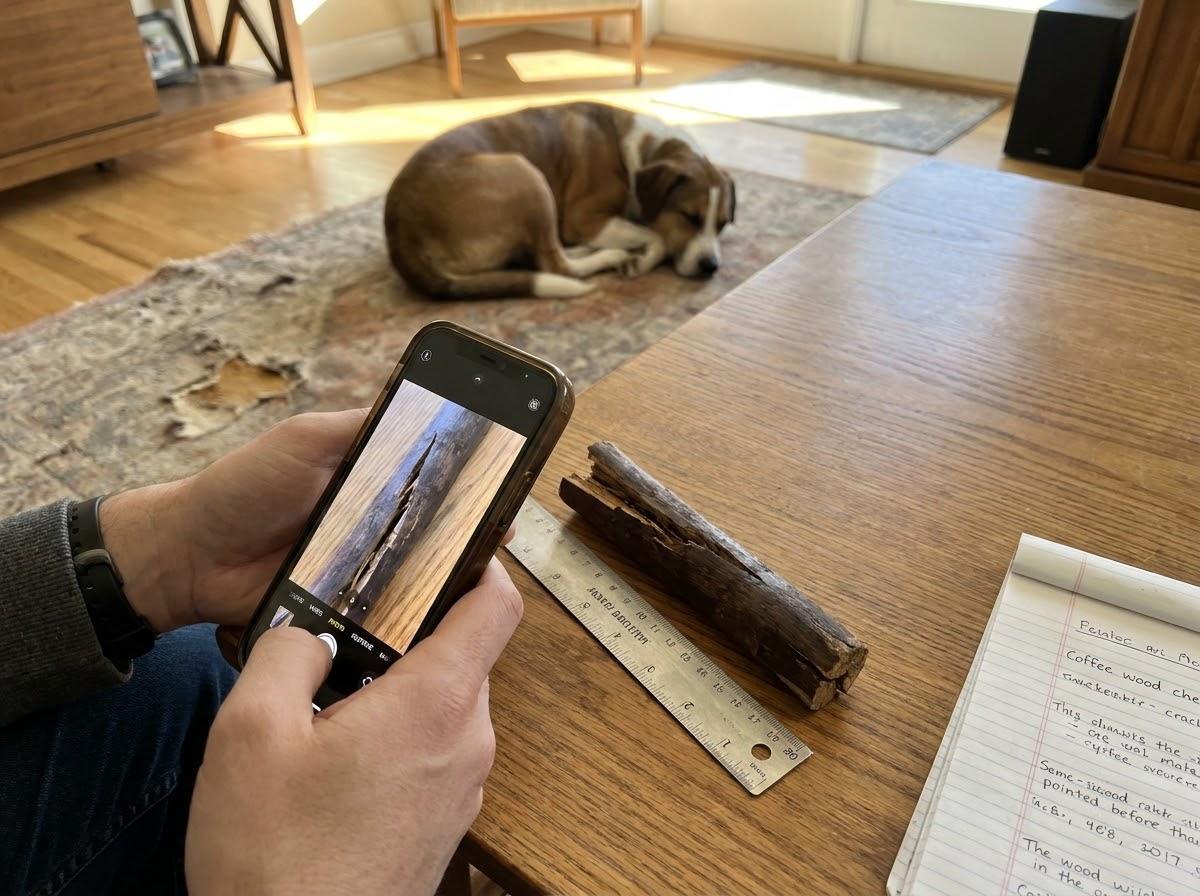
A structured report preserves the facts about a cracked or worn chew without turning a customer service response into a medical diagnosis.
Protect the dog first
If a coffee wood chew cracks, forms a sharp edge, or becomes small enough to swallow, stop use and remove it. Keep the damaged item if it can be stored safely, since photographs alone may not show the full condition.
If a dog may have swallowed a piece or shows symptoms, contact a veterinarian promptly. The retailer should not estimate the medical risk from a photograph or assure the owner that a fragment will pass.
Record the product details
Ask for the size label, order or purchase reference, date received, and clear photographs of the whole item and damaged area. A ruler in one photograph can provide scale without asking the customer to measure a sharp edge by hand.
Record how long the item had been in use, whether the dog was supervised, and the behavior observed when damage appeared. Keep the customer's description in their own words and separate it from staff interpretation.
Route the issue
Send the report to the person responsible for product quality and customer care. Compare the item with the current product record and any approved sample; do not infer a manufacturing defect from one image.
Where multiple reports show a similar pattern, review the batch or sourcing records if available. Avoid publishing a numerical failure rate unless the numerator, denominator, and collection method are known.
Close the loop carefully
Tell the customer what information has been received, what immediate use guidance applies, and when a human follow-up will be provided. Any return, refund, or replacement decision should follow the current policy and the facts of the case.
A good damage log can also improve public instructions. If customers repeatedly overlook an inspection step, rewrite the product page or care card so that the warning appears at the moment of use.
Example: one report, two tracks
Suppose a buyer sends a photo of a split chew and says the dog swallowed a piece. The immediate response should address the animal: stop use and contact a veterinarian. The product quality track should separately collect size, purchase details, photographs, and the remaining piece.
Keeping the tracks separate prevents a commercial refund conversation from being mistaken for a health assessment. It also preserves evidence needed to check whether the listing's inspection instructions were clear.
A report that another reviewer can use
Use one record per item and keep the original customer wording. Include the size, photographs of both ends and the whole chew, date of purchase, date the condition was noticed, and whether the item is available for inspection. If the item has a label or shipment reference, photograph it. Do not ask the owner to handle a sharp piece in order to obtain a closer image.
Write observations in plain language: 'one end has a visible lengthwise crack' or 'a loose piece was found next to the toy.' Avoid conclusions such as 'defective batch' or 'harmless flakes' before investigation. A report is more useful when another person can see what was observed and what remains uncertain.
The quality reviewer can compare the report with any approved reference sample and current instructions. If several reports share a condition, group them by actual product identifier and timeframe, not by a guess about cause. A pattern may justify a deeper supplier discussion, but the number of reports alone cannot establish a defect rate without knowing the number of items sold and how reports were collected.
Give customer service a separate closing field for the action taken under the current policy. A refund, replacement, or request for more evidence is a commercial outcome. A veterinary assessment is a clinical matter. Keeping these outcomes distinct protects the accuracy of the product record and makes future care instructions easier to improve.
After a case closes, review whether the current product instructions would have helped the buyer notice the condition earlier. If not, propose a precise wording or image change. Keep that editorial improvement separate from the determination of what caused one incident. The goal is to make the next customer's action clearer, even when the cause of the reported damage remains uncertain.
Frequently asked questions
Should a cracked coffee wood chew stay in use?
No. Remove it from use and document the damage; seek veterinary help if the dog swallowed a piece or shows concerning symptoms.

Coffee Wood Chew Stick
Dense coffee wood chew made from branches collected during routine pruning in Vietnam's Central Highlands. Available in six sizes for supervised chewing.
Ask for current availability, packaging options, and a written quote.
Have Questions or Need a Wholesale Quote?
We export high-quality, pet-friendly coffee wood chews and natural toys worldwide.
Partner with us!
✨ Wholesale Pricing Available for Resellers & Business Partners!
We offer competitive wholesale prices and attractive deals for resellers and distributors.
💬 Feel free to message me directly to discuss pricing, partnership opportunities, and further details. Let's grow our businesses together! 🤝